Sunday, May 11, 2014

Big Pines Zipline


We went Ziplining!!!!!!!
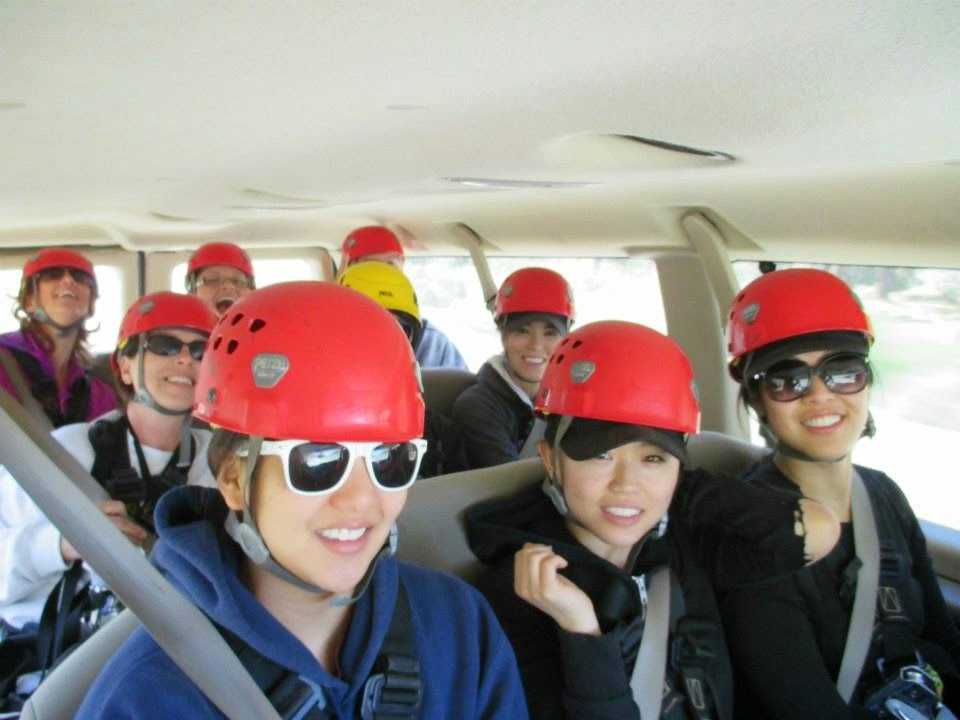

My mom is scared of heights, and made it through the first three!  She got off after that,but I am still proud. :)


So, ziplining was awesome, but I need to work on stopping... I almost took out the guides.  Poor guy.  

So much fun. 

I chickened out on the free fall repel, going backwards..... I have a fear of falling backwards... so I stayed going forward.  I think a redo is in order.  


Fear:  my mom faced a HUGE fear of hers today, took a step out, and finished a few of the ziplines.  After though, it got to her and she opted out.  Now though, she is as determined as ever to get this down, and I believe that she will.  She tells me though, that she feels embarrassed and ashamed, and those are totally valid, and recognizable feelings.  In reality though, she has no logical grounding to feel that.  She has a real phobia of heights, and she gave it a try.  That takes A LOT of energy, physical and emotional.  

To share a bit, I told her that on many hikes, I am so nervous, I cannot wait to get off the mountain.  I have a fear of slipping and falling off edges.  I get vertigo easily, and when you are looking at the world from the top of a mountain, vertigo comes too naturally.  In hiking Mt Baldy, there was even a point where I was so scared, I was ready to turn around.  Same in Mt Baden Powell, when we came across a ledge covered in ice. I freaking cried and really became paralyzed.  It's a terrible, and seemingly hopeless feeling, because you are racking your brain trying to find a way out of a situation that you have put yourself in, and that requires you to only move forward.  It's like when you climb up something, forgetting that coming down is scarier... and you have to get down.  

So, good job Mom.  Love you!


Friday, May 2, 2014

Managing Culture Shock

Culture shock can affect even the most veteran of expatriates, and potentially can derail what otherwise would be a successful assignment. Gokun Silver writes that there are three main steps to mastering culture shock, and outlines each step.

The Five Stages of Culture Shock

Stage I—also known as the “honeymoon stage.” During this stage, everything in the new place seems fascinating, interesting, and exciting. 
Stage II—during this stage, we begin to encounter daily struggles of living in the new environment and realize the great differences between the life we have known and the life we live now. This is the stage where most negative feelings surface because it is a time when we begin to set up our household, start grocery shopping for the first time, have a plumbing problem, and the like. Daily struggles, difficulty communicating and, in general, differences between our home life and our new life is often what produces deep dissatisfaction, hostility, anger, sadness, and feelings of incompetence. 
Stage III—during this stage, we begin to feel better because things are looking up. We are learning ways to live our new life, we start gaining some understanding of this new place, we know how to ask for what we need, and problems no longer seem grandiose.
Stage IV—during this stage, the new place starts feeling a little like home, we succeed in making local friends, we no longer fret a lot about bad things, and we enjoy the good things.

Stage V—also known as the “re-entry stage,” the stage when we have to return back to our home country. Many things we encounter on our return might be new to us because we have been absent for a number of years. Our friends have moved on and we still miss the “old” friends and connections we have made in the country we left. This stage is typical for “perpetual”expatriates in particular.


 Full Article: http://www.worldwideerc.org/Resources/MOBILITYarticles/Pages/1010-Silver.aspx

Silver, M. (2010). Three steps to managing culture shock. Mobility Magazine. Retrieved from http://www.worldwideerc.org/Resources/MOBILITYarticles/Pages/1010-Silver.aspx

Monday, April 21, 2014

Mt. San Gorgonio lessons learned

As always, there was something to learn on this trip, and we came home with a lot.


First and foremost, we learned that hikers help and support one another.  One other camper/hiker even offered to pump water for us, so that we didn't have to have the taste of the tablets we had brought instead... it was a cheaper option and we are broke college students alright.  

The next morning was Easter, and we woke up to early hikers making the summit.  We talked to one hiker who was taking a break, and we discussed how you have to pace yourself, and not be ashamed to face your limits.  Before she left, she ended up giving us two Easter Eggs... awesome.  :) Thank you lady!

We did end up facing our limitations and decided to head down instead of making the summit.  That was the best for both of us, Kim with her back, and me with my rehabbed ankle. 


Camping- Kim's first time!!! Poor thing, it got so cold at night.  I did not take into consideration that the temperature drops in higher altitude.. so the night temp at the bottom of the trail was expected to be in the 30's F, at around 5000-6000 ft.  We were at 9000 ft, so give or take 10/15 degrees at the least.  Cold.  We ended up opening our emergency space blankets, and those little things work miracles!  Our tent also got wet quickly, so condensation and precipitation were other factors we didn't take into consideration. 

My mummy bag was great, and kept dry, and the head part kept my head warm.  Kim, on the other hand, had a normal square sleeping bag, that didn't contain heat too well.  Again, poor girl.  The mats and tent definitely helped though.  This is a must.  

Also, I need to invest in layers for sleeping.  Kim brought a sauna suit, which was light, and actually worked well at containing heat.  I was reading that a silk insert can also help at this point.  


Out packs... too heavy.  30-35 pounds.  On the way down, I took some of the extra weight in my bag.  Part of the training I was able to do, was to hike with 30 pounds on my back.  The first time I did 10 miles with 30 pounds, I remember being so tired, uncomfortable, and in lots of pain with the bruising.  My hiking buddy was feeling this for the first time, while in higher elevation, tired, and hungry.  


There are many ways to reduce the weight in our bags, and the biggest way was to invest in a water filter and not bring up as much water as we did.  We also need to bring more higher calorie foods, that are also lighter  Our bags themselves, are a bit on the heavy side, and that can be taken care of sometime in the future, when we can afford to spend around 300 on a bag.  My friend needs to invest in a proper, and lighter sleeping bag though. The expense makes it difficult.

Sunday, April 20, 2014

Mt. San Gorgonio- Try#1

San Gorgonio Mountain is a tricky hike, with many ways to summit it.  It is the tallest peak in Southern California, standing at 11,503 ft.


There is a lot of prep that goes into this, including applying for permits to hike up the mountain.

You can request this here: http://www.sgwa.org/faq.html


We parked right below the Vivian Creek parking lot, which was closed, and then began our way up a road.  We then got to this, crossed it, and officially began the hike up.  


Here, our ascend consisted of switchback that led up the first parts, and then wound its way around the forest to Vivian Creek.  This is the first water source available.  


Savor the view on your way up. It is crazy, and neat to see these fallen trees.  You don't realize just how large they are, until you stand next to a fallen one.


Vivian Creek Camp

The hike felt a lot longer than what the map we had said it was.... and we started reading it at the wrong place... so we hoped beyond hope that we had made it to Halfway Camp early...


Then... we came to the sign that pointed to Halfway Camp on the right, and High Creek Camp to the left.


This part of the hike, felt like it went on forever.... It was the trail that never ends.  
The path first goes straight back, and then up switchbacks, around the mountain, and then straight onto the camp.


So take it slow and have some fun with it. 


 Again, the mileage felt off, but we were also struggling.  After asking a few hikers and getting wrong mileages so often, we finally got some helpful visuals from a hiker coming down. We were at the top of the switchbacks, and he told us that we just had to go around the mountain, in like a half circle. 

And so we did. 

And we came to a clearing...


And we thought we were in the clear, and we had finally reached the High Creek Camp... but no... we had not. 
And so we went on...

\

And on... 


And then... light!


So we came to discuss and learn many things from this point on, that I think I'll write up and include in another post.  We did decide to call it the next day, and head down, and so we did.


Mountain Women... I am a bit swollen... normal with elevation changes, but unfortunate. 


 Some Views: 

Sunday, March 30, 2014

Broke a personal record this week!

Tuesday- 8 miles w/ 20lb weight
Wednesday- 5 miles
Friday- 12 miles w/ 25lb weight
Total: 25 miles

BEYOTCH!!

The only thing that sucks... near the 20th mile, I started to get a sharp pain starting from the bottom outside of my foot, to the ankle, and behind the ankle bump.  I could climb rocks and hills fine, but once I got onto even ground, and put pressure evenly on my foot, my foot would shoot pain.

I remembered in Anatomy, learning about the muscle and tendon that wraps around the foot, and is what turns the foot outwards, and my best guess was that I had strained that muscle.

So I slowly made it home, trying not to complain too much, and made it to the doctors the next evening, after work (retail... frick...).  The diagnosis, Peroneal Tendonitis.... just what I had thought.  So now I am in this magic boot until the pain subsides, and I have to rest from hiking. :/

Why?!  I looked it up, and others with the same problem express the same frustrations, so at least I know I am not alone.


Here are some pics from the hikes at least :)